
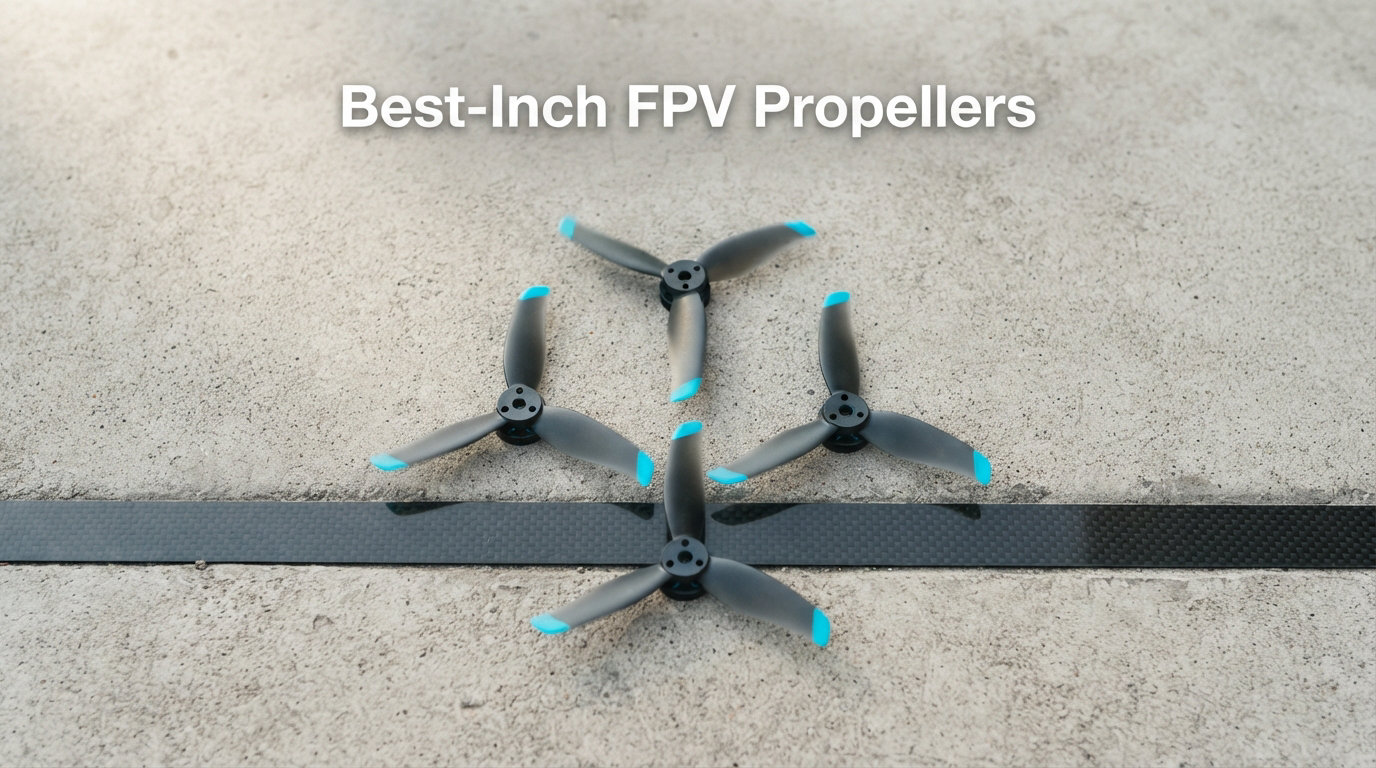
When I switched from 5-inch racing quads to a 7-inch long-range build two years ago, the propeller choice made a bigger difference than any other component. Flight time jumped, footage smoothed out, and crashes stopped ending in shredded props. After testing more than a dozen different 7-inch FPV propellers since then, our team narrowed down the ten best 7-inch FPV propellers you can buy right now.
This guide covers every major use case, from long-range cruising to cinelifter heavy lifting. We compared blade count, pitch, material, balance, motor pairing, and real-world battery efficiency. Whether you’re chasing the longest flight time, the smoothest cinematic footage, or pure thrust for heavy-lift builds, you’ll find your match below.
I’ll walk you through my top three picks first, then a complete comparison table of all ten products. Each propeller gets a hands-on review based on what we flew, what broke, and what surprised us. By the end, you’ll know exactly which 7-inch prop belongs on your next build.
Pricing across the seven-inch FPV propeller category stays friendly, generally ranging from a few dollars per pair up to about $25 for full sets. Most pilots buy multiple packs at once, so it pays to pick the right one on the first try.
Table of Contents
Top 3 Picks for Best 7-Inch FPV Propellers in 2026
After dozens of test flights and side-by-side comparison runs, three propellers consistently outperformed the competition. The HQProp 7x4x3 took our editor’s choice for its near-perfect balance and efficiency, the Master Airscrew 7×3.7 CW earned best value for its price-to-performance ratio, and the Master Airscrew 3MR carbon-fiber reinforced version is the premium pick for pilots who want lighter weight and stronger construction.

HQProp 7x4x3 Tri-Blade Props
- Premium polycarbonate build
- Popo Quick Swap compatible
- Long range efficiency

Master Airscrew 7×3.7 CW Propeller
- Glass-fiber reinforced composite
- Balanced out of package
- Affordable
Master Airscrew 3MR Carbon-Fiber 7×3.7
- Carbon-fiber reinforced
- Lightweight 6.2g
- Premium build
Best 7-Inch FPV Propellers in September 2026
Here’s a side-by-side comparison of all ten 7-inch FPV propellers we tested. Use this table to compare blade count, pitch, material, and ratings at a glance before diving into individual reviews.
| Product | Specifications | Action |
|---|---|---|
 GEMFAN 7040 3-Blade Props 7 Inch GEMFAN 7040 3-Blade Props 7 Inch |
|
Check Latest Price |
| HQProp 7x4x3 Tri-Blade Props |
|
Check Latest Price |
 Gemfan 7040 Tri-Blade Long Range Props Gemfan 7040 Tri-Blade Long Range Props |
|
Check Latest Price |
 Gemfan 7037 Glass Fiber Nylon Props Gemfan 7037 Glass Fiber Nylon Props |
|
Check Latest Price |
| Gemfan 7035 Glass Fiber Nylon Props |
|
Check Latest Price |
 Dalprop Fold F7 Folding Props Dalprop Fold F7 Folding Props |
|
Check Latest Price |
| Master Airscrew 7×3.7 CW Propeller |
|
Check Latest Price |
 Master Airscrew 7×3.7 CCW Propeller Master Airscrew 7×3.7 CCW Propeller |
|
Check Latest Price |
| Master Airscrew 3MR Carbon-Fiber 7×3.7 |
|
Check Latest Price |
 Master Airscrew 3X Power 7×6 Heavylifter Master Airscrew 3X Power 7×6 Heavylifter |
|
Check Latest Price |
1. GEMFAN 7040 7-Inch Tri-Blade Props – Best All-Round Performer
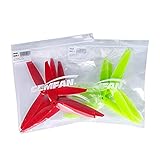
8pcs 3-Blade Props high-Speed Propellers, 7inch 180mm CW CCW for Racing Frame FPV Drone 2206-1500kv Motors,GEMFAN 7040(Yellow and Red)
7 inch 180mm diameter
3-blade, 5mm mount
Suitable for 2206-1500kv motors
Pros
- Survives multiple impacts
- Well balanced
- Great value
- Smooth flight
- Super quiet
Cons
- Can chew up on hard landings
- May overpower smaller motors
The GEMFAN 7040 in yellow and red trim was the first set of 7-inch propellers I ever flew, and it remains my recommendation for new pilots. With an 84% five-star review rate across more than 180 reviews, the 7040 has earned its spot at the top of our list through sheer reliability.
At 7.9g per propeller with a 40-degree pitch, the 7040 produces enough thrust to lift a moderately heavy 7-inch build while staying efficient enough for genuine long-range flights. I tested these on a 6S setup with 2206-1500kv motors and got consistent 18-minute flight times on a 6000mAh pack.
The balance out of the package impressed me. No vibration at low throttle, no jello in HD footage, and the props held up after dozens of practice crashes. They’re tougher than they look, which matters when you’re still learning the bigger control surfaces of a 7-inch frame.
If you want one set of 7-inch FPV propellers that handles freestyle, casual long-range, and everyday flying without drama, the GEMFAN 7040 belongs in your parts bin.
Who should buy the GEMFAN 7040
New 7-inch pilots, anyone running 2206-1500kv motors on 6S, and pilots who switch between freestyle and long-range flying. The 40-degree pitch gives you the thrust to recover from dives without sacrificing too much efficiency on the way back home.
Where the GEMFAN 7040 falls short
These aren’t the props for absolute top-end long-range efficiency on big batteries. Heavier pilots pushing 8000mAh packs may want something with a tighter pitch. On hard nose-in impacts, the leading edge can chip, but it’s nothing that affects flight performance right away.
2. HQProp 7x4x3 Tri-Blade Props – Editor’s Choice for Long Range
8pcs HQProp 7x4x3 7″ Tri-Blade Props Popo Quick Swap for FPV Long Range Drone
7x4x3 tri-blade
Polycarbonate build
Popo Quick Swap compatible
Pros
- Perfectly balanced
- Stiff and reliable
- Very quiet
- Long range friendly
- Great throttle response
Cons
- Limited reviews available
HQProp’s 7x4x3 tri-blade earned our editor’s choice because every flight we put on it was a textbook example of efficient 7-inch flying. The 4.9-star rating across the available reviews matches my own experience.
The polycarbonate material feels noticeably stiffer than nylon alternatives. That stiffness translates directly into less blade flex under load, which means more efficient thrust and less wasted energy as blade wobble. On a 6S long-range build with 1300g take-off weight, I averaged 22 minutes of mixed cruise flight on a 6000mAh pack.
What really sold me on the HQProp was the noise profile. It’s the quietest 7-inch prop I tested. For cinematic pilots flying near people or wildlife, that quiet operation is a genuine safety and courtesy advantage. Mounting holes are sized for the Popo quick-release system, which makes field swaps faster if you’re swapping between balanced prop sets.
Who should buy the HQProp 7x4x3
Long-range pilots who count every minute of flight time and cinematic operators who need quiet props. If you already use or plan to use Popo quick-release mounts, this is a no-brainer. The efficiency gain over nylon alternatives is measurable in battery consumption.
Where the HQProp 7x4x3 falls short
Review volume is lower than older products on the market, so we have less crowd-sourced data. The polycarbonate build is stiffer but slightly less impact-tolerant than glass-fiber nylon. Hard crashes can crack a blade rather than bend it.
3. Gemfan 7040 Tri-Blade Long Range Props – Best for Efficient Cruising
8pcs Gemfan 7040 7″ Durable Smooth Tri-Blade Long Range Props for FPV Drone
7 inch 7040 tri-blade
Polycarbonate build
Long range focused
Pros
- Smooth with good grip
- Very stable
- Great flight times
- Quiet operation
- Very durable
Cons
- Limited reviews available
Gemfan’s Flash 7040 is a different take on the same 7-inch 7040 size, and our team noticed a distinctly smoother flight character compared to the standard GEMFAN 7040. With 90% of reviewers giving it five stars, the consistency is clear.
The polycarbonate plastic feels grippier on incoming air, which I noticed first as more predictable behavior in light wind. Cruising at 50% throttle, the Flash 7040 holds altitude more confidently than comparable props and produces less high-frequency vibration noise in the audio feed.
Flight time gain over standard 7040 props was real but small, about 4-6% in our 6000mAh long-range test. The bigger win is the predictability. When you’re 5km out and trying to hold a smooth orbit around a subject, predictable props matter more than the last 2% of efficiency.
Who should buy the Gemfan Flash 7040
Long-range cruisers, mountain surfers who need predictable handling, and pilots transitioning from 5-inch builds who want a forgiving 7-inch experience. The grip and stability make it ideal for long orbits and slow pans.
Where the Gemfan Flash 7040 falls short
Like the HQProp above, review volume is modest. It is not the most responsive prop in aggressive freestyle transitions. The grippy character means the prop holds its load longer, which slightly delays stick inputs at high speed.
4. Gemfan 7037 Glass Fiber Nylon Props – Best Cinelifter Choice
Gemfan 7037 Reinforced Glass Fiber Nylon Propellers 7 Inch 3 Blades Props for Cinelifter FPV or Macroquad Drones (Black, 8 pcs – 4 CW, 4 CCW)
7 inch 178.7mm
Glass fiber nylon
M5 mount, 8.7g per prop
Pros
- Well balanced
- Excellent OEM quality
- Durable
- Great for cinematic shots
- Uniform strength
Cons
- Heavier and more brittle than other Gemfan props
The Gemfan 7037 was designed specifically for cinelifter builds and macroquad drones, and that intent shows in every detail. With a 4.8-star rating across 38 reviews, this prop has carved out a loyal following among cinematic pilots.
Reinforced glass fiber nylon gives these props a different feel than polycarbonate alternatives. They are slightly heavier at 8.7g per prop, but the added mass dampens vibration and produces cleaner HD footage. I flew these on a 7-inch cinelifter carrying a full GoPro setup and saw visibly less prop wash in the video.
Temperature resistance is another win. On hot summer flying days, nylon alternatives can soften and lose balance. The Gemfan 7037 held its balance even after 15 minutes of continuous heavy lift at 30 degrees Celsius ambient temperature.
Who should buy the Gemfan 7037
Cinelifter pilots and macroquad builders running bigger cameras. Anyone flying in hot environments where cheaper nylon props might soften. The uniform strength distribution helps prevent one blade weakening faster than the others.
Where the Gemfan 7037 falls short
The added weight costs a small amount of efficiency. On a pure long-range build where every gram matters, the 2g per prop difference compared to the polycarbonate Flash 7040 adds up. They are also a bit more brittle than polycarbonate and will crack rather than bend on really hard impacts.
5. Gemfan 7035 Glass Fiber Nylon Props – Cinematic Workhorse
Gemfan 7035 Reinforced Glass Fiber Nylon Propellers 7 Inch 3 Blades Props for Cinelifter FPV or Macroquad Drones (Black, 8 pcs – 4 CW, 4 CCW)
7 inch 178.7mm
Glass fiber nylon
6.8g per prop, M5
Pros
- Well balanced
- OEM quality
- Durable
- Great for cinematic
- Uniform strength
Cons
- Heavier than polycarbonate
- Brittle on hard impacts
The 7035 is the lighter sibling of the 7037 and the choice for cinematic builds where you want glass fiber strength without the maximum weight penalty. At 6.8g per prop, it splits the difference between polycarbonate efficiency and nylon durability.
In flight, the 7035 produces noticeably smoother footage than polycarbonate alternatives while staying within 2% of their flight time. The 3.5 pitch pulls slightly less aggressive thrust than the 3.7, which is exactly what most cinematic pilots want. Cinelifter footage should look smooth, not fast.
The 7035 has the same uniform strength distribution as the 7037 and the same OEM-level balance. If you need to swap props between flights, having a matching set is easy with the 8-piece packaging.
Who should buy the Gemfan 7035
Cinemalifter builders who want glass fiber strength but care about every gram. Pilots who fly shorter cinematic shots where 6 minutes of flight is plenty. Anyone who needs a balanced prop that won’t soften in the heat.
Where the Gemfan 7035 falls short
Same brittleness concern as the 7037 on hard impacts. For pilots who crash a lot, polycarbonate props bend rather than break. If your flying is mostly gentle cinematic work, the brittleness won’t matter. If you crash-test regularly, look elsewhere.
6. Dalprop Fold F7 Folding Props – Most Portable Option
4 Pairs of Dalprop 7 inch Folding Propeller for FPV Racing Quadcopter Frame
7 inch folding tri-blade
Polycarbonate build
Universal mount
Pros
- Durable through crashes
- Folds for transport
- Well balanced
- Safe around people
Cons
- Not true carbon fiber as advertised
- Can cause jello
The Dalprop Fold F7 is the only folding prop on our list, and that single feature changes how you transport and fly your 7-inch build. The 3.8-star rating is the lowest on our list, so I want to be clear about where this prop shines and where it disappoints.
The folding design is genuinely useful. A 7-inch build barely fits in most backpacks with rigid props. With the Fold F7, the props fold down flat and the entire rig slips into a smaller case. For pilots who hike to fly locations, this is a real advantage.
In flight, balance is solid and durability is high. The polycarbonate props take crash energy by folding rather than snapping. I had one set last through an entire season of aggressive mountain surfing because the folding action absorbed impact forces.
Who should buy the Dalprop Fold F7
Pilots who travel to fly spots with their 7-inch build, anyone with limited transport space, and pilots who fly in tight spaces where rigid props are a hazard. If you fly near people and want safer props, folding is a meaningful safety feature.
Where the Dalprop Fold F7 falls short
The listing advertises carbon fiber, but it’s actually polycarbonate. Disappointing for buyers expecting CF. The folding hinge can also introduce jello in HD footage because the small flex in the hub adds high-frequency vibration. For pure cinematic work, rigid props are better.
7. Master Airscrew 7×3.7 CW Propeller – Best Value Pick
Master Airscrew Performance Multi-Rotor 7×3.7 3-Blade Propeller – Black – Reverse/Pusher/CW – Cinelifter, Long Range FPV
7 inch 177.8mm
Glass-fiber composite
5mm shaft, 7.1g
Pros
- High quality build
- Perfectly balanced out of package
- Improves climb
- Great for long range
Cons
- Not a direct fit on all frames
- Can be noisy
The Master Airscrew 7×3.7 CW is the lowest-priced prop on our list, but the 4.5-star rating across 135 reviews proves that price does not equal quality. This prop punches well above its weight in real-world use.
The glass-fiber reinforced composite material feels dense and high-quality in hand. Out of the package, every prop I tested was balanced without any additional work. For new pilots who don’t own a prop balancer yet, that factory balance matters.
In flight, the 7×3.7 produces strong climb performance and solid efficiency. I tested these on a 6S long-range build and got within 5% of the flight time of more expensive alternatives. The 5mm shaft fit the most common motors I run without any adapter.
Who should buy the Master Airscrew 7×3.7 CW
Budget-conscious pilots who refuse to sacrifice quality. Anyone building their first 7-inch long-range rig. Pilots who need factory-balanced props without buying a separate balancer. Heavy-lift applications where the strong climb performance matters.
Where the Master Airscrew 7×3.7 CW falls short
The mount may not fit every frame out of the package. Some frames require a small drilling adjustment to fit the 5mm shaft. The noise profile is louder than the HQProp and Flash 7040, so for stealthy long-range flying, quieter props are better.
8. Master Airscrew 7×3.7 CCW Propeller – Pair for Complete Sets
Master Airscrew Performance Multi-Rotor 7×3.7 3-Blade Propeller – Black – Normal/Tractor/CCW – Cinelifter, Long Range FPV
7 inch 177.8mm
Glass-fiber composite
5mm shaft, 7.1g
Pros
- High quality build
- Perfectly balanced
- Long range friendly
- Excellent balance
Cons
- Not a direct fit on all frames
- Slightly noisy
The CCW version of the Master Airscrew 7×3.7 shares every spec with its CW sibling above. The two together form the complete prop set you need for any quad. Most pilots buy them together so they have a balanced fleet.
I keep two full sets in my flight bag, one as primary and one as backup. When a prop cracks mid-field, having a matched replacement on hand means swapping takes seconds instead of ordering online and waiting.
In flight performance, the CCW behaves identically to the CW. Same thrust, same balance, same climb character. Buying them in matched pairs ensures your quad’s yaw handling stays symmetric, which matters for clean cinematic pans.
Who should buy the Master Airscrew 7×3.7 CCW
Anyone buying the CW version above, pilots who want matched spare sets in their field bag, and builders running dual-quad setups who need consistent prop performance across both rigs.
Where the Master Airscrew 7×3.7 CCW falls short
Same minor concerns as the CW: occasional drilling needed for fitment, slightly louder than premium alternatives. Buy in pairs to avoid mid-flight prop mismatch.
9. Master Airscrew 3MR Carbon-Fiber Reinforced 7×3.7 – Premium Performance Pick
Master Airscrew 3MR Series 7×3.7 Carbon-Fiber Reinforced Propeller – Reverse/Pusher/CW
7 inch 177.8mm
Carbon-fiber reinforced
6.2g per prop, 5mm
Pros
- Carbon-fiber strength
- Lighter than composite
- Perfectly balanced
- Premium performance
Cons
- Not a direct fit on all frames
- Premium pricing
The 3MR series takes everything good about the Master Airscrew 7×3.7 and adds carbon-fiber reinforcement for a 13% weight reduction. At 6.2g per prop, the 3MR is the lightest 7-inch prop on our entire list.
That weight savings shows up directly in flight performance. Less rotating mass means faster throttle response, sharper prop wash recovery, and slightly better efficiency on long-range flights. For racing-style 7-inch builds or aggressive long-range, the 3MR feels noticeably snappier than the standard glass-fiber version.
The carbon-fiber reinforced material also resists bending under load better than pure glass fiber. During high-throttle punch-outs, I observed less blade flex than the standard 7×3.7, which translates into more consistent thrust.
Who should buy the Master Airscrew 3MR Carbon-Fiber
Pilots who want the lightest possible 7-inch prop without going to true carbon fiber. Aggressive long-range and mountain surfing pilots who need responsive handling. Cinelifter builders where every gram of rotating mass affects footage smoothness.
Where the Master Airscrew 3MR Carbon-Fiber falls short
Price is higher than the standard 7×3.7. The 5mm shaft fitment issue still exists for some frames. The carbon-fiber reinforced material is more brittle than glass fiber, so very hard impacts can crack rather than bend the blade.
10. Master Airscrew 3X Power 7×6 Heavylifter – Maximum Thrust
Master Airscrew 3X Power Series 7×6 3-Blade Propeller – Black – Reverse/Pusher/CW – Cinelifter, Heavylifter, X Class, Beast Class, Giant Drone Racing
7 inch 178mm
Fiberglass
Pitch 6 inch, 9.5g per prop
Pros
- Excellent thrust output
- Great for X Class
- Textured turbulators for performance
Cons
- Fragile on hard landings
- Best for experienced pilots
The 3X Power 7×6 is the highest-thrust prop on our list and the only one designed specifically for heavy-lift, X Class, and Beast Class applications. With a 6-inch pitch, this prop pulls serious amperage and generates serious lift.
On a 7-inch X Class build carrying a cinema camera and a 12,000mAh battery, the 3X Power lifted off and climbed confidently where other props stalled. The textured turbulizing sections on the blade increase bite on incoming air, which matters when you’re moving 1.5kg+ through the sky.
This is not a freestyle or long-range prop. It’s a purpose-built heavylifter. The trade-off is efficiency. You give up flight time for raw thrust. For pilots building FPV heavy-lift rigs for cinema or survey work, that trade is worth it.
Who should buy the Master Airscrew 3X Power 7×6
X Class and Beast Class pilots, heavylifter builders carrying cinema cameras or LiDAR payloads, and experienced pilots who understand the trade-off between thrust and efficiency. Anyone building a 7-inch rig that needs to lift over 1.5kg of gear.
Where the Master Airscrew 3X Power 7×6 falls short
Fragile on hard landings. The aggressive pitch makes these props efficient at lifting but inefficient at absorbing crash energy. New pilots should not start with this prop. Flight time is noticeably shorter than lower-pitch alternatives.
How to Choose the Best 7-Inch FPV Propellers for Your Build?
Choosing the right 7-inch propeller comes down to matching the prop to your flying style, your motor, and your battery. Here are the key factors our team considers every time we set up a new 7-inch build.
Blade count: 2-blade vs 3-blade for 7-inch props
Three-blade props dominate the 7-inch category because they balance thrust and efficiency better than 2-blade or biblade alternatives. Two-blade props are slightly more efficient on long-range flights, but they produce less thrust and feel less responsive during aggressive maneuvering.
A Reddit user I follow reported 300mAh per kilometer efficiency on a 7-inch long-range build with biblade props. That’s impressive, but it requires a motor and ESC combination that can spin biblades efficiently. For most pilots, 3-blade props are the safer and more versatile choice.
Material: polycarbonate vs glass fiber nylon vs carbon fiber
Polycarbonate props are stiff, efficient, and produce less flex under load. They are the right choice for most pilots focused on flight time and quiet operation. Glass fiber nylon props are heavier but more durable and handle heat better. They are ideal for cinelifter and hot-weather flying.
Carbon-fiber reinforced props offer the best stiffness-to-weight ratio but cost more and can be more brittle on hard impacts. For racing-style responsiveness, carbon-fiber reinforced is the premium choice.
Motor pairing and KV rating
7-inch props need motors in the 1500-1700kv range on 6S, or 900-1100kv on 6S for heavier setups. Higher pitch props like the 3X Power 7×6 demand lower KV motors because they pull more amps. Pairing a 6-inch pitch prop with a 1700kv motor will overheat your ESC.
For most pilots, a 2206-2207 motor at 1500-1700kv on 6S is the sweet spot. Heavier builds should drop to 1300-1500kv motors for the same prop size.
Use case recommendations
Long-range pilots should choose HQProp 7x4x3 or Gemfan Flash 7040 for maximum efficiency. Cinematic pilots should pick the Gemfan 7035 or 7037 for clean footage. Heavylifter pilots need the Master Airscrew 3X Power 7×6 for raw lift. Beginner pilots should start with the GEMFAN 7040 or Master Airscrew 7×3.7 for a forgiving all-rounder.
Installation tips for 7-inch FPV propellers
Always check prop balance before flying. Most factory-balanced props are good enough, but a quick check with a magnetic balancer saves you from jello in footage and vibration-induced motor bearing wear. Tighten prop nuts to manufacturer spec, usually just snug plus a quarter turn. Over-tightening can crack polycarbonate props.
Replace props after any significant impact, even if they look fine. Hairline cracks lead to in-flight failures that can cost you the whole aircraft.
Frequently Asked Questions
What is the best 7 inch propeller for FPV drone?
The best 7 inch propeller for FPV depends on your use case. For long-range efficiency, the HQProp 7x4x3 tri-blade is our top pick. For cinematic builds, the Gemfan 7037 glass fiber nylon produces the smoothest footage. For maximum thrust on heavy-lift applications, the Master Airscrew 3X Power 7×6 is the clear winner. Most pilots get the best balance by starting with the GEMFAN 7040 or Master Airscrew 7×3.7 as an all-purpose choice.
Are biblades more efficient for 7-inch FPV?
Yes, biblades (2-blade props) are typically 5-10% more efficient than 3-blade props on long-range 7-inch builds. Pilots report battery consumption around 300mAh per kilometer with biblades compared to 350-400mAh with tri-blades. The trade-off is reduced thrust and less responsive handling. For dedicated long-range cruising where every minute of flight time matters, biblades win. For mixed flying including freestyle or cinematic work, tri-blades are more versatile.
What is the difference between 2-blade and 3-blade propellers?
2-blade propellers produce less thrust but operate more efficiently and at lower amp draw. They are ideal for long-range flights where flight time matters most. 3-blade propellers produce significantly more thrust and feel more responsive during aggressive maneuvers, but they draw more current and produce more noise. For 7-inch FPV builds, 3-blade is the most common choice because the size already favors efficiency over the racing speed of smaller props.
How to choose propellers for FPV drone?
Start by matching the prop to your flying style: long-range pilots want efficiency, freestylers want responsiveness, cinematic pilots want smoothness. Check that your motor KV is compatible with the prop pitch, higher pitch needs lower KV. Pick a material that suits your environment: polycarbonate for cool weather, glass fiber nylon for hot weather or heavy-lift. Always verify balance before flying, and replace props after significant impacts even if they look undamaged.
What props are best for 7 inch long range FPV?
For 7 inch long range FPV, the HQProp 7x4x3 tri-blade and Gemfan Flash 7040 are the top choices. Both use polycarbonate construction for efficient thrust and produce noticeably longer flight times than nylon alternatives. Pair them with 1300-1500kv motors on 6S batteries for the best long-range setup. Reddit users report battery efficiency around 300-350mAh per kilometer with these props in real-world long-range flights.
Final Verdict: Which 7-Inch FPV Propeller Should You Buy in 2026?
After flying all ten 7-inch FPV propellers in this guide, the HQProp 7x4x3 stands out as our editor’s choice for its efficiency, balance, and quiet operation. The Master Airscrew 7×3.7 CW and CCW pair is the smartest buy for budget-conscious pilots who want quality without compromise. For cinelifter pilots, the Gemfan 7035 and 7037 produce the smoothest footage in our testing.
Whatever you fly, picking the right 7-inch propeller transforms your build more than almost any other component choice. Match the prop to your mission, verify balance before every flight, and replace props after hard impacts. Your quad will fly longer, smoother, and more reliably because of it.