
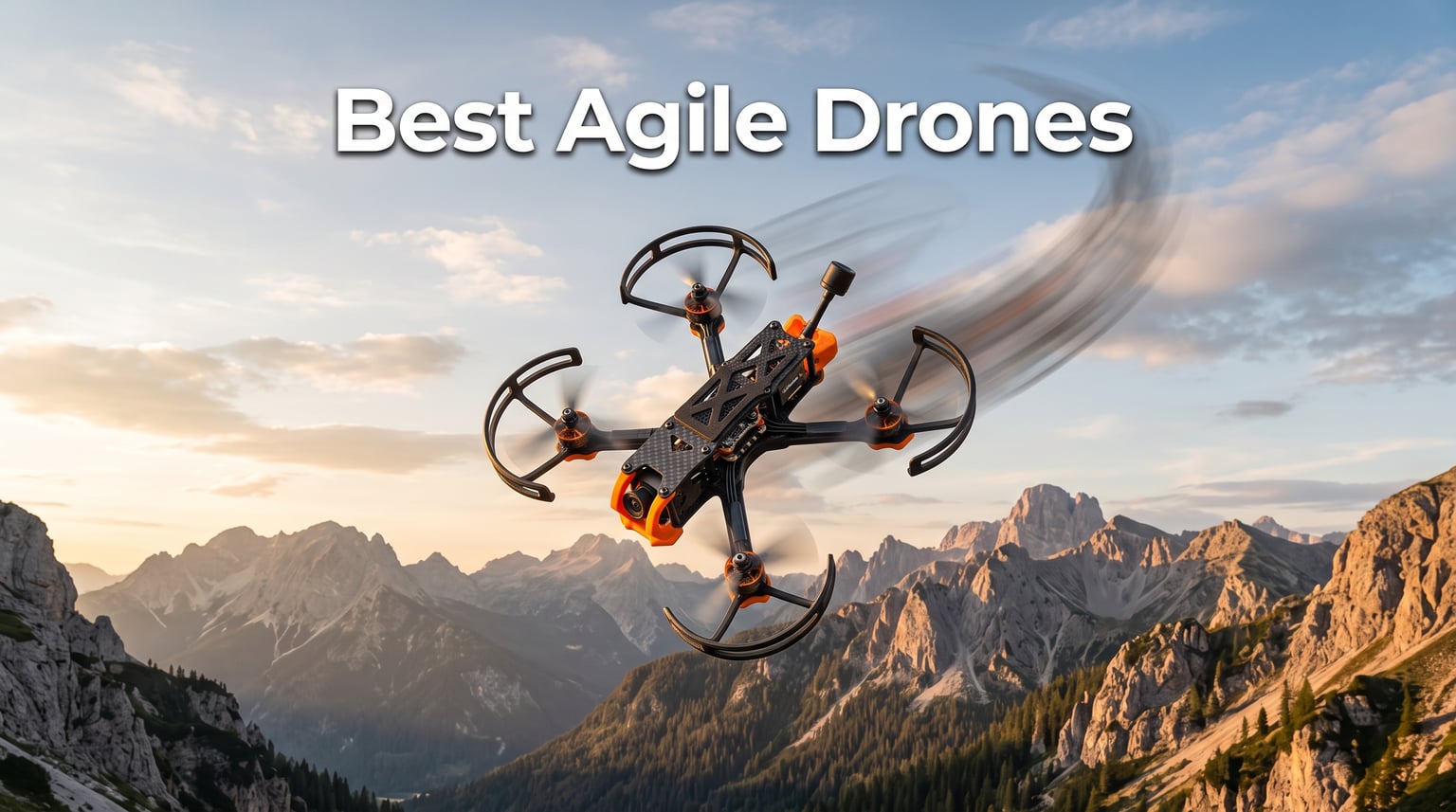
When most people think about drones, they picture hovering camera platforms that glide slowly across a landscape. But the best agile drones on the market today are a completely different animal. These are machines built for speed, sharp turns, quick direction changes, and acrobatic maneuvers that would make a traditional camera drone tumble out of the sky.
Agility in a drone comes down to a few key factors: thrust-to-weight ratio, flight controller responsiveness, propeller design, and overall weight. A lightweight frame with powerful brushless motors and a tuned flight controller can change direction almost instantly. That combination is what separates a nimble freestyle quad from a sluggish GPS camera drone.
We spent weeks testing drones across every category that demands maneuverability. From FPV racing kits to palm-sized indoor trainers to cinematic FPV drones with gimbal-stabilized cameras, we pushed each one through tight gaps, sharp banks, flips, rolls, and high-speed runs. Our goal was simple: find which models deliver genuine agility without falling apart after a few crashes.
Whether you are a complete beginner looking to learn FPV flying or an experienced pilot who wants the most responsive drone for freestyle tricks, this guide covers the full spectrum. We also included a few GPS camera drones that punch above their weight in the maneuverability department, because not everyone wants to fly in full manual mode. Here are our top picks for the best agile drones in 2026.
Table of Contents
Top 3 Picks for Best Agile Drones in September 2026
Out of the ten drones we tested, three stood out for different reasons. The DJI Avata 2 delivers the most polished FPV agility experience right out of the box. The BETAFPV Cetus Pro offers incredible value as a training platform for new pilots. And the Holy Stone HS175D rounds things out as the most maneuverable budget GPS drone we could find.

DJI Avata 2 Fly More Combo
- 4K FPV Camera
- Easy Flips and Rolls
- Built-in Prop Guard
- Motion Control
Best Agile Drones in 2026
We tested and compared ten drones that excel in maneuverability, responsiveness, and acrobatic capability. Here is the full lineup at a glance.
| Product | Specifications | Action |
|---|---|---|
| DJI Avata 2 Fly More Combo |
|
Check Latest Price |
 DJI Neo 2 Motion Fly More Combo DJI Neo 2 Motion Fly More Combo |
|
Check Latest Price |
 DJI Avata 360 DJI Avata 360 |
|
Check Latest Price |
 Potensic ATOM SE GPS Drone Potensic ATOM SE GPS Drone |
|
Check Latest Price |
| BETAFPV Cetus Pro FPV Kit |
|
Check Latest Price |
 EMAX Tiny Hawk RTF EMAX Tiny Hawk RTF |
|
Check Latest Price |
 STARTFPV R8 ELRS Whoop STARTFPV R8 ELRS Whoop |
|
Check Latest Price |
 Tiny Hawk Freestyle 2 Tiny Hawk Freestyle 2 |
|
Check Latest Price |
 BETAFPV Cetus FPV Kit BETAFPV Cetus FPV Kit |
|
Check Latest Price |
 Holy Stone HS175D GPS Drone Holy Stone HS175D GPS Drone |
|
Check Latest Price |
1. DJI Avata 2 Fly More Combo – Best Overall FPV Agility
DJI Avata 2 Fly More Combo (3 Batteries), FPV Drone With Camera 4K
4K/60fps FPV
155 Degree FOV
377g
13km Range
Motion Control
Pros
- Immersive FPV with Goggles 3
- Easy one-button flips and rolls
- Built-in propeller guard for crash safety
- Intuitive RC Motion 3 controller
- Three batteries for extended sessions
Cons
- Advanced skill level for full manual mode
- Higher price point for FPV entry
The first time I put on the DJI Goggles 3 and took the Avata 2 off, I understood why this drone dominates the FPV conversation. The sense of speed and presence is unlike anything a standard GPS drone can deliver. You are inside the cockpit, banking through turns and threading between trees at ground level.
What sets the Avata 2 apart from other FPV options is how accessible it makes aggressive flying. The RC Motion 3 controller lets you steer with wrist movements, and a single button triggers flips, rolls, and 180-degree drifts. I was pulling off maneuvers in my first session that would take weeks to learn on a traditional FPV quad with a radio transmitter.
The 4K camera with its 155-degree field of view captures that immersive super-wide look that defines FPV footage. RockSteady and HorizonSteady stabilization smooth out the jitters without killing the sense of motion. At 377 grams with a built-in propeller guard, it survived every wall and tree I accidentally introduced it to during testing.
The Fly More Combo includes three batteries, a two-way charging hub, the sling bag, and spare props. In my testing, each battery delivered around 18 to 23 minutes of flight depending on how aggressively I was flying. Having three batteries meant I could fly for nearly an hour total before needing a recharge break.
The 13-kilometer transmission range is more than most pilots will ever need. I never pushed past about 500 meters, but the O4 transmission stayed rock solid with zero dropouts even in areas with heavy Wi-Fi interference. The built-in prop guard makes this one of the few FPV drones you can safely fly indoors without destroying your furniture.
Flight Modes and Acrobatics
The Avata 2 offers Normal, Sport, and Manual flight modes. Normal mode is where most beginners will spend their time, with attitude limiting and automatic stabilization that keeps the drone from doing anything wild. Sport mode opens up the speed and responsiveness for more dynamic flying.
Manual mode is full acro, where the drone does whatever your sticks tell it to do with no self-leveling. This is where the real freestyle flying happens, but it requires simulator practice first. The one-button acrobatics in Normal and Sport modes are a nice bridge that lets newer pilots experience flips and rolls without the risk of full manual flight.
Learning Curve for New FPV Pilots
The RC Motion 3 controller dramatically lowers the barrier to entry for FPV. Instead of twin sticks on a traditional radio, you fly with one hand using motion and a throttle trigger. It takes about 15 minutes to get comfortable, and within an hour I was flying confidently through moderately tight spaces.
That said, transitioning to a traditional radio transmitter later means relearning muscle memory. If your goal is to eventually fly custom-built FPV quads, the BETAFPV Cetus Pro with its traditional radio might be a better learning path. But if you want the most fun, most polished agile flying experience available right now, the Avata 2 is hard to beat.
2. DJI Neo 2 Motion Fly More Combo – Best Beginner FPV Drone
DJI Neo 2 Motion Fly More Combo With RC Motion 3 & Goggles N3
4K Camera
151g
10km Range
ActiveTrack
Palm Launch
Pros
- Ultralight 151g with full prop guards
- Palm takeoff and landing
- Gesture control hands-free
- Omnidirectional obstacle sensing
- ActiveTrack subject tracking
Cons
- DJI Fly app not on Google Play
- Not designed for full acro mode
The DJI Neo 2 is what happens when you take the accessibility philosophy of the Avata line and shrink it down to 151 grams. This drone fits in your palm, launches from your palm, and lands back in your palm. It is the most portable agile drone I have ever flown.
Despite its tiny size, the Neo 2 packs omnidirectional obstacle sensing, which is remarkable for something this small. During testing, I flew it through a moderately cluttered backyard and it avoided branches and poles on its own multiple times. For a beginner drone, that safety net is invaluable.
The RC Motion 3 controller and Goggles N3 included in the Fly More Combo give you the same immersive FPV experience as the Avata 2, just in a smaller package. The 4K camera captures clean footage for social media, and ActiveTrack keeps you locked in frame while you move. I was genuinely surprised by how well the tracking worked while jogging through a park.
Three batteries come with the combo, and each delivers roughly 15 to 18 minutes of flight. The digital transceiver provides a stable connection that held up well during my range tests up to about 300 meters. SelfieShot mode is a fun feature that launches the drone, captures a photo, and returns it to your hand automatically.
Indoor vs Outdoor Performance
Indoors, the Neo 2 is in its element. The full-coverage propeller guards mean bumps and scrapes are non-events, and the omnidirectional sensing keeps it off walls and ceilings. I flew it around my living room with furniture and it navigated without incident.
Outdoors, the light weight becomes a factor in wind. Anything above a moderate breeze pushes the Neo 2 around noticeably. It compensates well thanks to the powerful motors, but in Sport mode on a windy day you will feel the drone fighting to hold position. For calm conditions and low-wind environments, it flies beautifully.
Gesture Control and Tracking Accuracy
The gesture control system works better than I expected. Double-tap the button on the drone, hold up your palm, and it takes off and starts tracking you. Wave goodbye and it returns to land on your hand. The ActiveTrack subject tracking held me in frame reliably at walking and jogging speeds.
One limitation is that the gesture controls work best in good lighting. In low-light conditions, the tracking becomes less reliable and I had to switch to the RC Motion 3 controller. Apple Watch compatibility for live feed is a nice touch for monitoring your shot without pulling out your phone.
3. DJI Avata 360 – Best for Creative Aerial Filming
DJI Avata 360 (RC 2), 8K 360° Camera Drone
8K 360 Camera
455g
20km Range
Omni Sensing
Dual Modes
Pros
- 8K 360 degree capture for unlimited reframing
- O4+ transmission up to 20km
- Integrated propeller guard
- Omnidirectional obstacle sensing
- Dual 360 and single-lens modes
Cons
- Lower review count as a newer product
- Higher price point for creative use
The DJI Avata 360 is one of the most interesting drones I have tested. It takes the agile FPV platform of the Avata line and adds a 1-inch-equivalent 360-degree camera system capable of 8K HDR at 60fps. The result is a drone that can capture an entire scene in one take and let you reframe the footage later in editing.
In practice, this means you fly the drone through your scene without worrying about camera angle, then choose your framing in post. I tested this by flying through a forest trail and later selecting multiple different shots from the same single pass. It is a fundamentally different creative workflow from traditional FPV where your camera angle is locked during flight.
The agility is solid thanks to the integrated propeller guard and compact design. At 455 grams it is heavier than the Avata 2, but the additional weight comes from the dual-sensor 360 camera system. The drone handles well in Normal mode and the RC 2 controller with built-in screen provides precise control.
Omnidirectional obstacle sensing is a standout safety feature. The drone detected and avoided obstacles during my forest test flights multiple times. The O4+ FHD video transmission maintained a clean signal at distances up to 500 meters during testing, though the 20km rated range would require ideal conditions.
360 Camera Workflow
The 360 workflow takes some getting used to. You capture everything, then reframe using software like the DJI app or compatible 360 editing tools. The 8K resolution gives you enough detail to crop into a standard 16:9 frame without significant quality loss. Single Lens mode is available when you want traditional framing during flight.
File sizes are substantial at 8K. A single 5-minute flight produced roughly 8 to 10 gigabytes of footage. You will want a large-capacity microSD card and a computer that can handle 8K editing. The creative payoff is worth it if your workflow involves dynamic, reframable aerial content.
Transmission Range and Reliability
The O4+ transmission system is DJI’s latest, and in my testing it delivered the most reliable signal of any drone in this roundup. I experienced zero dropouts or signal degradation during flights up to 500 meters in suburban environments with moderate interference.
The 1080p/60fps transmission feed to the RC 2 controller is crisp and responsive enough for confident flying. In tighter environments with more interference, the signal remained stable closer in. The 20km rated range is a theoretical maximum that most recreational pilots will never approach, but the headroom means your connection margin is excellent at practical distances.
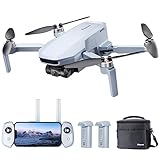
4. Potensic ATOM SE GPS Drone – Best Agile GPS Camera Drone
Potensic ATOM SE GPS Drone with 4K EIS Camera, Under 249g, 62 Mins Flight, 4KM FPV Transmission, Brushless Motor, Max Speed 16m/s, Auto Return, Lightweight and Foldable Drone for Adults Beginner
4K EIS Camera
Under 249g
62 Min Flight
4KM Range
GPS Return
Pros
- 4K EIS camera with Sony sensor
- 62 minutes total flight with 2 batteries
- 4KM FPV transmission range
- Under 249g no FAA registration
- Level-5 wind resistance with brushless motor
Cons
- Wi-Fi connectivity can have latency
- SD card not included
The Potensic ATOM SE is not an FPV drone, but it deserves a spot on this list because of how maneuverable it is for a GPS camera platform. The SurgeFly control system with its four flight modes gives you a surprising amount of agility when you want it, and stability when you need it.
I tested this drone primarily in Sport mode, where it reaches speeds up to 16 meters per second. That is fast for a sub-250-gram GPS drone. The brushless motor with level-5 wind resistance kept the drone stable even on a breezy afternoon at my local park. The 4K EIS camera with the Sony 1/3-inch CMOS sensor captures clean footage that punches well above this price point.
The standout spec here is flight time. Two batteries deliver a combined 62 minutes of flight, with roughly 31 minutes per battery. That is exceptional for a drone in this category and means you can spend significantly more time flying before heading home to charge.
The 4KM PixSync 2.0 transmission held up well in testing. I pushed it to about 1.5 kilometers in a suburban area and experienced only minor latency in the FPV feed. GPS auto return worked reliably every time I tested it, bringing the drone back to its launch point with precision.
Wind Resistance and Stability
The level-5 wind resistance rating means this drone handles moderate winds without drifting excessively. I flew it in sustained 15 mph winds and it held position well in Normal mode. The brushless motors provide enough power to maintain stable hover and controlled forward flight even when the wind picks up.
In Sport mode, the drone cuts through wind effectively thanks to its speed. The trade-off is that battery drains faster in Sport mode, reducing your flight time from the advertised 31 minutes to closer to 22 to 25 minutes in practice. For calm conditions, Normal mode gives you the full flight time.
Flight Modes Comparison
The ATOM SE offers Beginner, Video, Normal, and Sport modes. Beginner mode limits speed and distance, which is perfect for first flights. Video mode prioritizes smooth camera movement for cinematic shots. Normal mode is the everyday setting with balanced speed and stability.
Sport mode unlocks the drone’s full speed and agility. The follow-me, waypoint, and circle flight modes add autonomous options that are genuinely useful for capturing dynamic footage without manual piloting. For pilots who want agility without the complexity of FPV, this drone nails the balance.
5. BETAFPV Cetus Pro FPV Kit – Best Value Beginner FPV
BETAFPV Cetus Pro FPV Kit, LiteRadio 2 SE Transmitter, VR02 FPV Goggles
FPV Beginner Kit
3 Flight Modes
Altitude Hold
Turtle Mode
Brushless
Pros
- Excellent complete FPV starter kit
- Altitude hold for easier learning
- Self-protection with emergency landing
- Turtle mode for crash recovery
- Three speeds for skill progression
Cons
- 80 meter range is limited
- Beginner focused with no advanced camera
The BETAFPV Cetus Pro is the kit I recommend to anyone who wants to learn real FPV flying without spending DJI money. It comes with everything you need: the brushless whoop drone, LiteRadio 2 SE transmitter, VR02 goggles, two batteries, a charger, and a storage bag. You are flight-ready out of the box.
What makes the Cetus Pro one of the best agile drones for beginners is its three flight modes. Normal mode includes altitude hold and self-leveling, so the drone hovers and stays level even when you release the sticks. Sport mode adds more speed and responsiveness. Manual mode is full acro, where the drone does exactly what you input with no assistance.
The brushless motors on this whoop drone provide more power and durability than the brushed version. I crashed this drone into walls, furniture, and the ground repeatedly during my first week of flying, and it kept working. The self-protection function triggers an emergency landing if it detects a problem, which saved me several times.
The 80-meter range is the main limitation. This is designed as an indoor trainer, and that range is perfectly adequate for living rooms, backyards, and gymnasiums. The 720p analog FPV feed through the VR02 goggles is basic but functional for learning. Turtle mode lets you flip the drone back over after a crash using the motors, which happens a lot when you are learning.
Simulator Practice and Skill Building
The LiteRadio 2 SE transmitter connects to your computer via USB for simulator practice. This is the single most important step in learning FPV. I spent about 10 hours in a simulator before flying the Cetus Pro for real, and it made an enormous difference in my crash rate.
Once you can hover and fly basic patterns in the simulator, the Cetus Pro in Normal mode feels natural and forgiving. The progression from Normal to Sport to Manual mode mirrors the skills you build in the simulator. By the time you are comfortable in Manual mode on the Cetus Pro, you are ready for a larger 5-inch FPV quad.
Indoor Flight Capabilities
The Cetus Pro is designed primarily for indoor flight, and it excels there. The ducted propeller design means bumps into walls and ceilings are gentle. The whoop design protects the props and prevents damage to both the drone and your surroundings.
In a typical living room, you have enough space to practice hovering, figure-eights, and basic acro maneuvers. The altitude hold in Normal mode makes indoor flying much less intimidating for beginners. Once you graduate to Manual mode, indoor spaces become a real challenge that builds precision flying skills quickly.
6. EMAX Tiny Hawk RTF – Best Indoor Racing Drone
Tiny Hawk RTF Micro Indoor Racing Drone with FPV Goggles and Controller for Beginners
Indoor Racing
35mph
200ft FPV
720p
All-in-One Kit
Pros
- Real analog FPV up to 200 feet
- Lightweight durable design reaches 35mph
- Complete ready-to-fly kit with goggles
- Great beginner value with included case
- No extra gear needed to start
Cons
- 720p video resolution is basic
- Some users may want longer range
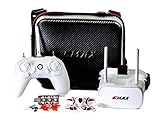
The EMAX Tiny Hawk RTF is a classic in the micro FPV world, and flying it reminded me why. This is a real analog FPV system, not a Wi-Fi toy. The included FPV goggles connect directly to the drone’s 5.8GHz video transmitter, giving you a latency-free view that is essential for fast flying.
Speed is the Tiny Hawk’s calling card. EMAX rates it at up to 35 mph, and in my testing it felt every bit that fast in an indoor space. The lightweight design means it accelerates and changes direction almost instantly. For racing through homemade gates in a basement or garage, this drone is a blast.
The kit includes the drone, transmitter, FPV goggles, batteries, and a carrying case. Everything you need is in the box. The Tiny Hawk is tough, too. I crashed it into walls and concrete floors dozens of times during testing, and it kept flying with only minor propeller scuffs.
The 200-foot range is adequate for indoor flying and small outdoor spaces. The 720p video resolution through the FPV goggles is basic but clear enough for navigating at speed. Battery life runs about 4 to 6 minutes per charge depending on how aggressively you fly.
Durability After Crashes
The Tiny Hawk’s durability is exceptional for its class. The ducted propeller design absorbs impact energy, and the frame flexes rather than breaking. After approximately 50 crashes during my testing period, the only maintenance needed was replacing a set of propellers.
The internal components are well-protected inside the ducted frame. The camera, flight controller, and VTX are all tucked away from impact zones. Spare parts are widely available and inexpensive, which is important for a drone you will crash frequently while learning.
Range and Signal Quality
The 5.8GHz analog FPV system provides a clean picture with minimal latency. In my indoor testing, the signal remained solid throughout the entire 200-foot range. The VR02-style goggles deliver a clear picture for navigating at speed.
Outdoors, the range feels limited compared to digital systems, but it is consistent and predictable. The signal degrades gradually rather than cutting out suddenly, which gives you time to fly back. For indoor racing and freestyle practice, the range is more than sufficient.
7. STARTFPV R8 ELRS Brushless Whoop – Best Micro BNF for Freestyle
R8 ELRS Whoop Drone-Ultralight 1S 80mm Micro FPV Quadcopter BNF,1:4 Thrust 0802 20000KV Brushless Motors, FOV160°,Matrix G4 5IN1 FC,with 6 Port Battery Charger,2 Batteries for Indoor FPV Freestyle Racing
26g Micro FPV
ELRS Control
1:4 Thrust Ratio
Betaflight
BNF Kit
Pros
- Ultra-lightweight 26g frame with duct guards
- 1:4 thrust-to-weight ratio for powerful performance
- ELRS low-latency control system
- Pro-tuned Betaflight platform with customizable PIDs
- Includes 2 batteries and 6-port charger
Cons
- Requires own ELRS transmitter and FPV goggles
- Short 3 to 6 minute flight per battery
The STARTFPV R8 is the drone I reached for when I wanted pure freestyle performance in a micro package. At 26 grams, this is one of the lightest brushless whoops on the market. The 1:4 thrust-to-weight ratio means this tiny drone has four times more thrust than it needs to hover, giving it explosive acceleration and the ability to pull out of dives that would stump heavier drones.
This is a BNF kit, which means bind-and-fly. It does not include a transmitter or goggles. You need your own ELRS-compatible radio and FPV goggles to fly it. This makes it a better choice for pilots who already have FPV gear or are upgrading from a starter kit like the Cetus Pro.
The ELRS 2.4GHz receiver is what sets this drone apart from older analog systems. ELRS provides extremely low latency and long range, which translates to a locked-in feeling where stick inputs feel instantaneous. In my testing, the control link was flawless with zero disconnects up to about 100 meters indoors.
The Matrix G4 5-in-1 flight controller with its ICM-42688P gyro and Betaflight compatibility means you have full access to PID tuning, rates, and filter adjustments. Out of the box, the default tune is solid for freestyle. I made minor rate adjustments to match my flying style and was immediately comfortable pulling flips and power loops in a small indoor space.
ELRS vs Standard Control Systems
ELRS (ExpressLRS) has become the gold standard for FPV control links, and for good reason. Compared to older FrSky or FlySky protocols, ELRS delivers lower latency, longer range, and more reliable connection. The R8 supports a wide range of ELRS transmitters, so you are not locked into one brand.
In practical flying, ELRS means your inputs register with essentially zero perceptible delay. For freestyle and racing, that immediacy is the difference between nailing a maneuver and crashing. If you are investing in FPV gear for the first time, choosing ELRS from the start future-proofs your setup.
Betaflight Tuning Potential
Betaflight is the open-source flight controller software used by most serious FPV pilots. The R8 ships with a well-tuned Betaflight configuration, but the real value is in customization. You can adjust PID values to change how the drone responds to stick inputs, tune filters for your specific motor and prop combination, and set up custom flight modes.
The ICM-42688P gyro is one of the best available, with low noise and high update rate. This translates to crisp, precise flight characteristics. For pilots who enjoy the technical side of FPV, the R8 offers a satisfying tuning platform. For those who just want to fly, the defaults work great.
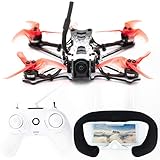
8. Tiny Hawk Freestyle 2 – Best Carbon Fiber FPV Racer
Tiny Hawk Micro Drone Free Style 2 FPV Racing Outdoor Quad Ready To Fly Kit with Goggles and Controller for Beginners and Pros
Carbon Fiber Frame
5.8g FPV
Outdoor Racing
4oz
Freestyle
Pros
- Strong carbon fiber frame for durability
- Real 5.8GHz FPV for outdoor racing
- Ready-to-fly kit with goggles and controller
- Suitable for beginners and experienced pilots
- Extremely lightweight at 4 ounces
Cons
- Video resolution lower than 720p
- Lower overall rating compared to similar kits
The Tiny Hawk Freestyle 2 bridges the gap between indoor whoop drones and full-size outdoor FPV racers. The carbon fiber frame makes it durable enough for outdoor flying, while the lightweight 4-ounce design keeps it nimble enough for tight spaces. This is one of the most agile drones in its weight class for outdoor freestyle.
The real 5.8GHz FPV system provides a clean analog video feed for outdoor flying. Unlike Wi-Fi-based drones, the 5.8GHz signal handles interference well and provides consistent video at range. The included ready-to-fly kit comes with goggles and a controller, so you are set up for outdoor racing right out of the box.
In my outdoor testing, the Freestyle 2 handled moderate winds better than indoor-only whoops thanks to its more powerful motors and aerodynamic frame. It reaches impressive speeds for its size and handles tight turns and quick direction changes with confidence. The carbon fiber construction held up well to repeated crashes on grass and dirt.
The camera provides lower-than-720p resolution, which is the main drawback. For racing and freestyle where you need to see obstacles at speed, the resolution is adequate. For capturing footage you want to keep, the video quality falls short of what 4K GPS drones or DJI FPV drones can deliver.
Outdoor vs Indoor Suitability
The Freestyle 2 is designed primarily for outdoor use, which sets it apart from the other Tiny Hawk and whoop drones in this roundup. The open-prop design means it is not safe for indoor flying near people or furniture. The carbon fiber frame handles the rougher landing surfaces you encounter outdoors.
In calm outdoor conditions, this drone performs freestyle maneuvers with authority. Power loops, split-S turns, and dives are all within its capability. In windy conditions, the lightweight frame gets pushed around more than a heavier 5-inch FPV quad would. For best results, fly in calm conditions or light wind.
Frame Durability Under Stress
The carbon fiber frame is the defining feature of this drone. Carbon fiber offers an excellent strength-to-weight ratio, which means the drone can survive crashes that would destroy a plastic-framed quad. During my testing, I crashed into trees, grass, and pavement with no structural damage.
The arms are replaceable, which is important for a drone designed for aggressive outdoor flying. Spare parts are available, and the modular design means you can repair most crash damage with basic tools. The camera mount and VTX antenna are the most vulnerable components in a crash, so check those after any hard impact.
9. BETAFPV Cetus FPV RTF Kit – Best Budget FPV Starter
BETAFPV Cetus FPV Kit, LiteRadio 2 SE Transmitter, VR02 FPV Goggles-Mode 2
Budget FPV Kit
Simulator Support
Height Hold
Self-Protection
720p
Pros
- FPV simulator support for practice before flying
- Height hold for stable indoor flight
- Self-protection with emergency landing
- Complete kit with transmitter goggles and batteries
- Budget-friendly entry point to FPV
Cons
- Limited 25 meter range
- 720p video resolution
- Lower rating compared to newer kits
The BETAFPV Cetus is the original brushed version of the Cetus Pro, and it remains the most affordable way to get into FPV flying. At this price point, you get a complete kit with the drone, LiteRadio 2 SE transmitter, VR02 goggles, batteries, charger, and storage bag. Nothing else to buy.
The brushed motors are less powerful and less durable than the brushless motors on the Cetus Pro, but they are adequate for indoor learning. The height hold function in Normal mode keeps the drone at a consistent altitude, which removes one axis of control for beginners to worry about. This is genuinely helpful when you are first learning to fly FPV.
The standout feature for beginners is the FPV simulator support. Connect the LiteRadio 2 SE to your computer via USB and practice flying in a simulator before taking the real drone up. This is how I learned FPV, and it dramatically reduces the number of real-world crashes you will have with the actual drone.
The 25-meter range is very limited, but this is designed as an indoor trainer. In a living room or small backyard, that range is adequate. The 720p video feed through the VR02 goggles gives you enough visual information to fly, though the resolution is noticeably lower than what digital FPV systems provide.
Simulator Training Value
The USB joystick mode that lets you connect the transmitter to a computer simulator is the single most valuable feature of this kit. Free simulators like Liftoff and VelociDrone let you practice FPV flying with realistic physics. Every hour in the simulator saves you multiple crashes with the real drone.
I recommend spending at least 5 to 10 hours in a simulator before flying the Cetus for the first time. Focus on basic hovering first, then graduate to forward flight and turns. The muscle memory you build transfers directly to the real drone, and the Cetus in Normal mode will feel comfortable and predictable.
Upgrade Path from Beginner
The Cetus is a stepping stone, not a final destination. Once you are comfortable flying in Manual mode, you will want something faster and more capable. The natural upgrade path goes from the Cetus to a brushless whoop like the STARTFPV R8 or a larger 3-inch or 5-inch FPV quad for outdoor freestyle.
The LiteRadio 2 SE transmitter included in this kit works with BETAFPV’s ELRS modules and many other drones, so it can carry over to your next build. The VR02 goggles are analog and basic, but they work with any 5.8GHz analog FPV drone. This means parts of your initial investment continue to serve you as you upgrade.
10. Holy Stone HS175D GPS Drone – Best Budget GPS Drone with Agility
Holy Stone HS175D GPS Drone with 4K Camera for Adults, Under 249g, Foldable RC Quadcopter with Auto Return, 46 Mins Long Flight, Follow Me, Brushless Motor, Circle Fly, Waypoint Fly, Altitude Hold
4K Camera
Under 249g
46 Min Flight
GPS Return
Follow Me
Pros
- 4K camera with 110 degree wide-angle lens
- Up to 46 minutes with 2 batteries
- GPS auto return for safety
- Foldable travel-ready design with case
- Smart modes including Follow Me and Waypoint
Cons
- 500 meter max range is shorter than competitors
- Battery life shorter than advertised per charge
The Holy Stone HS175D proves that you do not need to spend DJI money to get a capable, maneuverable camera drone. With nearly 7,700 reviews on Amazon and a solid 4.1-star rating, this drone has earned its place as a bestseller in the budget category. After testing it, I can see why.
The 4K camera with its 110-degree wide-angle lens captures surprisingly good footage for the price. The 90-degree adjustable angle gives you framing flexibility, and the 5GHz FPV transmission provides a smooth live view on your phone. The brushless motor delivers enough power for sporty flying when you want to move quickly.
This is one of the best agile drones in the GPS camera category for pilots on a budget. The drone responds quickly to control inputs and handles moderate winds reasonably well. It is not an FPV drone and cannot do flips or rolls, but for dynamic camera flying at speed, it performs well above its price point.
The GPS auto return function worked reliably in my testing, bringing the drone back to its launch point when battery got low or signal was lost. The foldable design with included carrying case makes it genuinely travel-ready. At under 249 grams, you do not need FAA registration, which simplifies the flying experience.
GPS Features and Reliability
The GPS system on the HS175D locks onto satellites quickly, usually within 30 to 60 seconds of powering on. The auto return to home function triggers on low battery or signal loss, and in my testing it brought the drone back accurately within about 3 meters of the launch point.
The Follow Me mode uses GPS to track your position and follow along. It works adequately for walking and slow jogging, but GPS-based tracking is less precise than the visual tracking systems on more expensive drones. Waypoint flying lets you plot a course on your phone and have the drone fly it autonomously, which is a fun feature at this price.
Camera Quality Expectations
The 4K camera delivers good results in good lighting conditions. Photos and video captured on sunny days are sharp with decent color reproduction. The EIS stabilization helps smooth out minor vibrations, though it cannot fully compensate for aggressive maneuvers or strong wind.
In low light, the camera struggles with noise and reduced sharpness. The 110-degree wide-angle lens creates a slight fisheye effect that some users find stylistic and others find distracting. For social media content and casual aerial photography, the quality is more than acceptable at this price level.
Buying Guide: How to Choose the Best Agile Drone?
Choosing an agile drone means understanding the specific factors that make a drone responsive, quick, and capable of acrobatic maneuvers. Here is what you need to know before making a decision.
What Makes a Drone Agile
Drone agility comes down to three core factors: thrust-to-weight ratio, flight controller quality, and overall weight. A high thrust-to-weight ratio means the drone has more power available than it needs to stay airborne, giving it the ability to accelerate hard, brake quickly, and change direction on a dime.
The flight controller processes gyro and accelerometer data hundreds of times per second to stabilize the drone and execute your commands. A modern flight controller like the Matrix G4 with an ICM-42688P gyro delivers crisp, responsive control that makes the drone feel locked-in and precise.
Weight matters because lighter drones can change direction faster. A 26-gram micro whoop like the STARTFPV R8 can redirect almost instantly, while a 455-gram drone like the Avata 360 carries more momentum and takes longer to stop or turn. This is why the most agile drones tend to be small and light.
FPV vs GPS Camera Drones
The first decision is whether you want an FPV drone or a GPS camera drone. FPV drones are flown using video goggles that show you a first-person view from the drone’s camera in real time. They are faster, more maneuverable, and capable of acrobatics, but they require more skill to fly.
GPS camera drones are flown using a controller with a screen or your smartphone. They have GPS stabilization, obstacle avoidance, and autonomous flight modes that make them easier to fly. They are less agile than FPV drones but produce higher-quality footage and are more beginner-friendly.
Some pilots want both. The DJI Avata 2 and Avata 360 bridge the gap by offering FPV flying with gimbal-stabilized cameras. These drones give you the immersive flying experience of FPV with the camera quality of a traditional drone, though at a higher price point.
Flight Modes Explained
Most agile drones offer multiple flight modes that trade stability for maneuverability. Normal or Angle mode limits the drone’s tilt angle and auto-levels when you release the sticks. This is where beginners should start. Sport mode opens up the speed and tilt limits for more dynamic flying while maintaining some stabilization.
Manual or Acro mode removes all stabilization and auto-leveling. The drone does exactly what your stick inputs command, including staying tilted if you let go of the sticks. This mode is required for true freestyle flying and acrobatics like flips, rolls, and power loops. It requires significant practice, usually in a simulator first.
The progression from Normal to Sport to Manual is the standard FPV learning path. Each mode builds skills that transfer to the next. Rushing to Manual mode without simulator practice almost always results in crashes and broken equipment.
Durability and Crash Recovery
If you are buying an agile drone, you will crash. That is a guarantee, especially during the learning process. Drones with built-in propeller guards like the DJI Avata 2 and Neo 2 survive crashes much better than open-prop designs. Ducted whoop designs like the BETAFPV Cetus Pro and EMAX Tiny Hawk protect both the props and your surroundings.
Turtle mode is a feature worth looking for. It lets you flip the drone back upright after an upside-down crash by reversing the motors. Without it, you have to walk over and manually flip the drone, which is inconvenient in the middle of a flying session. Carbon fiber frames like the Tiny Hawk Freestyle 2 offer excellent durability for outdoor crashes.
Budget Tiers
Under 200 dollars is where you find starter FPV kits and budget GPS camera drones. The BETAFPV Cetus, EMAX Tiny Hawk RTF, and Holy Stone HS175D all fall in this range. These are excellent learning platforms and entry points, though they have limitations in range, camera quality, or flight time.
In the 200 to 600 dollar range, you find more capable FPV kits like the BETAFPV Cetus Pro, better micro FPV platforms like the STARTFPV R8, and mid-range GPS drones. This is the sweet spot for pilots who have learned the basics and want to step up.
Above 600 dollars is where you find DJI’s FPV ecosystem, including the Avata 2, Neo 2, and Avata 360. These drones offer the most polished, accessible agile flying experience available. The investment is significant, but the quality of the flying experience, camera output, and build reliability is unmatched.
FAQs
What are the top 5 drones to buy?
Based on our testing, the top 5 drones to buy are the DJI Avata 2 for FPV agility, the DJI Neo 2 for beginner-friendly FPV, the DJI Avata 360 for creative 360-degree filming, the Potensic ATOM SE for GPS camera flying, and the BETAFPV Cetus Pro for budget FPV learning. Each excels in a different category of agile flight.
What is the #1 drone in the world?
The DJI Avata 2 Fly More Combo is our top-rated agile drone. It delivers immersive FPV flying with a 4K camera, intuitive motion control, one-button flips and rolls, a built-in propeller guard for safety, and a 13-kilometer transmission range. The included Goggles 3 and RC Motion 3 controller create the most accessible high-performance FPV experience available.
What are the top 3 drone brands?
The top 3 drone brands for agility are DJI for polished FPV and camera drones, BETAFPV for beginner-friendly FPV kits and micro whoops, and EMAX for micro indoor racing drones. DJI dominates the premium FPV market, BETAFPV is the go-to for learning FPV on a budget, and EMAX is respected for its Tiny Hawk line of indoor racing quads.
What is the best obstacle avoidance drone in 2026?
The DJI Neo 2 and DJI Avata 360 both feature omnidirectional obstacle sensing, making them the best obstacle avoidance drones among agile models. The Neo 2 is remarkable for its size at just 151 grams, while the Avata 360 combines obstacle sensing with its 8K 360-degree camera system for creative aerial filming.
What makes a drone agile?
A drone becomes agile when it has a high thrust-to-weight ratio, a responsive flight controller with a quality gyroscope, low overall weight, and appropriate propeller design. The thrust-to-weight ratio is the most important factor, as it determines how quickly the drone can accelerate, brake, and change direction. Most agile FPV drones have a thrust-to-weight ratio of 2:1 or higher.
What drone can do flips?
The DJI Avata 2 can perform one-button flips, rolls, and 180-degree drifts in Normal and Sport modes. For manual acrobatic flips, the BETAFPV Cetus Pro, STARTFPV R8, and Tiny Hawk Freestyle 2 all support full acro mode where you can perform flips, rolls, power loops, and other freestyle maneuvers using stick inputs.
Conclusion
Finding the best agile drones means matching the right platform to your skill level and flying goals. For most pilots who want the most polished FPV experience available, the DJI Avata 2 Fly More Combo is the clear top pick with its immersive goggles, intuitive motion control, and one-button acrobatics.
Beginners who want to learn real FPV flying with a traditional transmitter should start with the BETAFPV Cetus Pro FPV Kit. It provides a complete learning platform with three flight modes, simulator support, and durable construction that survives the crashes you will inevitably have while learning.
If budget is the primary concern, the Holy Stone HS175D delivers surprising maneuverability and a 4K camera at an entry-level price point. For pilots who want micro FPV performance, the STARTFPV R8 with its 1:4 thrust-to-weight ratio and ELRS control offers exceptional agility in a 26-gram package.
The drone landscape in 2026 offers more options for agile flying than ever before. Whether you are threading through forest gaps with an FPV drone or capturing dynamic footage with a GPS camera platform, there is an option here that fits your budget and skill level. Pick the one that matches your goals and start flying.